research
own-baseline validation for single-cell potency scores
independent, open source. may 2026 - present.
the standard way the field validates a potency score cannot separate biological signal from a sequencing-depth confound. i replaced it with a conditional test: does the score order cells better than its own low-order statistic already does?
calibrated on 39,505 cells across twelve microscopy-staged timepoints, where the ordering is fixed before the cells are processed. audited fourteen published scores and placed nine on that ordering: six of the nine beat their own baseline under the registered reading, and four also beat it read in the direction their authors give.
status: under review at ml4h 2026
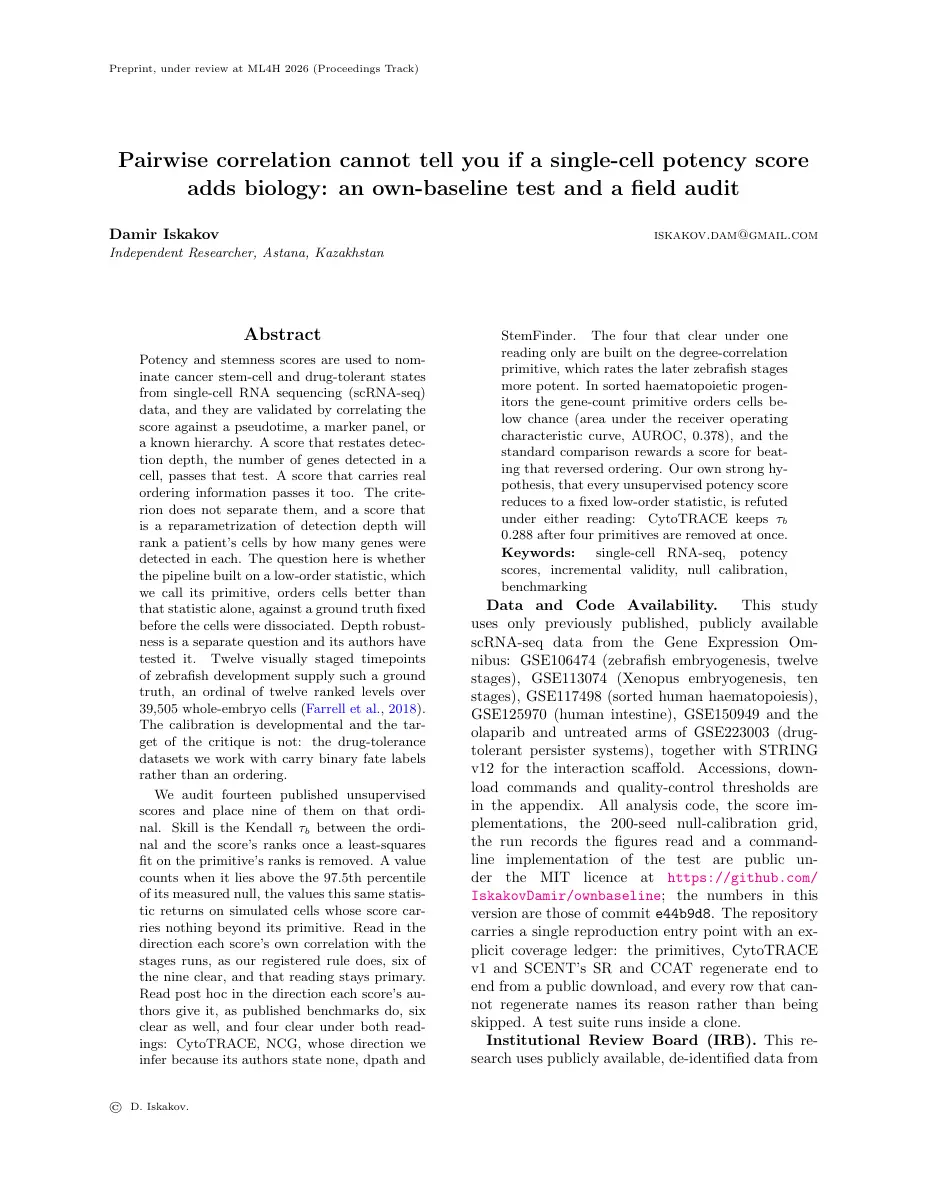 the paper, pdf ↗22 pages
code, mit licence: github.com/IskakovDamir/ownbaseline
the command line, install and scope: own-baseline
the rise of the ai-augmented solo-founder
redefining team structures in early-stage startups. jun - dec 2025.
interviewed 100+ founders from y combinator, startx, and unicorn companies. co-authored with aldamzhar kiikbayev, guided by prof. poh kam wong (nus business school) and geoffrey moore.
coelacanth
independent. sep 2026 - present.
a benchmark for systems that check whether a scientific idea has been done before. it pairs claims from one field with earlier work from other fields that may describe the same thing under another name. systems see only the claim, in its own field’s vocabulary.
every pair carries a typed relation, from equivalent to nothing close, backed by quotes that code checks verbatim against the source. people choose every label. each item is also put to language models with no search, to tell retrieval from recall.
built to measure how often existing novelty and precedent checkers miss cross-field rediscoveries.
status: in preparation
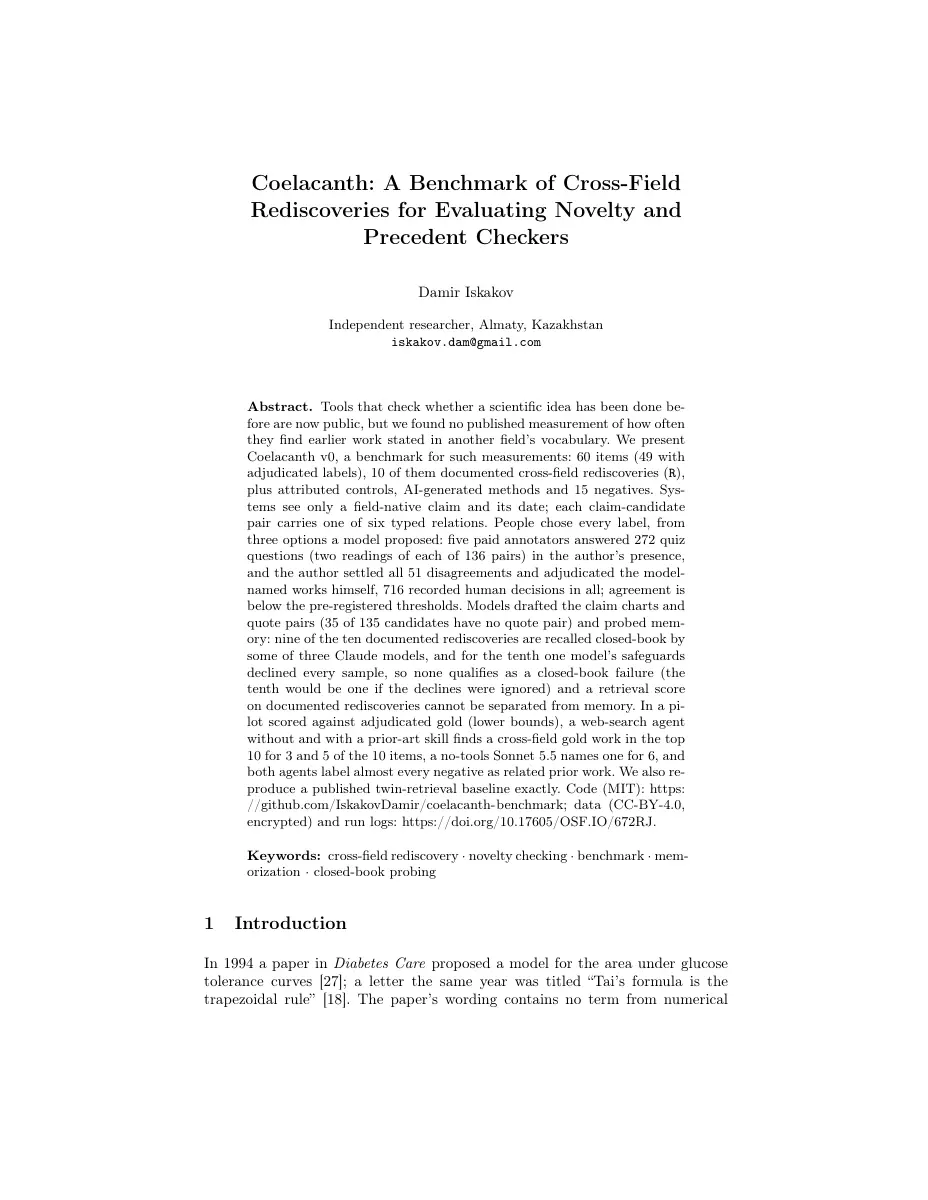 the paper, pdf ↗18 pages
code, mit licence: github.com/IskakovDamir/coelacanth-benchmark
data and run logs, cc-by-4.0, in a password-protected archive: doi.org/10.17605/osf.io/672rj
the benchmark on its own page: coelacanth